Ecosystem readiness in the Pacific Islands
How the Ecosystem Readiness Assessment reshaped the question from where a regional cluster should be to how ready each nation is to build its own.
At a glance
- Where: four individual Pacific Island nations, plus a regional view, as part of the Global Ocean Clusters project.
- The fishery: a well-managed, wild-capture migratory tuna fishery whose by-products have historically been inaccessible to local island communities and remain underutilized.
- Who responded: roles across government, industry, and community, from investment managers at regional NGOs and funds to national fisheries managers and private fishing and processing companies.
- Key finding: a single shared regional cluster would be impractical; the path forward is proving one successful model, then letting the region's collaborative strength carry it outward.
Why the Pacific Islands
The Ecosystem Readiness Assessment tool was developed as part of the Global Ocean Clusters project to support the development of 100% seafood utilization ecosystems across the Pacific. The region's wild-capture migratory tuna fishery underpins food security, government revenue, and livelihoods across Pacific Island nations. Its stocks are well managed, but byproducts from tuna processing have historically been inaccessible to local island communities and remain underutilized. Strengthening local value capture from the fishery's byproducts could help improve the region's economic resilience and opportunity without increasing pressure on tuna stocks.
Because Pacific Island nations have a history of collaboration and shared resources, there was initial interest in pooling efforts to develop a shared utilization cluster that could efficiently build value from the region's catch and increase collective resilience. The Ecosystem Readiness Assessment challenged that assumption. Dispersed geography, distinct governance structures, different industry profiles, significant political differences, and most importantly, differences in the level of infrastructure development and reliability, showed that a single regional structure would be both impractical and counterproductive. As these insights surfaced, the project pivoted from asking where a cluster should be to asking how ready each nation is to develop its own cluster, and where they can collaborate for mutual gain and economic growth. The Ecosystem Readiness Assessment became the central tool in answering that question, allowing Pacific Island nations to think collaboratively while developing plans for local action.
How the readiness assessment was run
The Ecosystem Readiness Assessment was deployed across four individual Pacific Island nations and a regional view using the methods from the how-to guide. These nations are widely dispersed throughout the Pacific and differ meaningfully in their industry profiles, infrastructure levels, and governance contexts. The Iceland Ocean Cluster gathered responses from a range of roles across government, industry, and community, and the diversity of perspectives surfaced insights that would not have emerged from a single viewpoint.
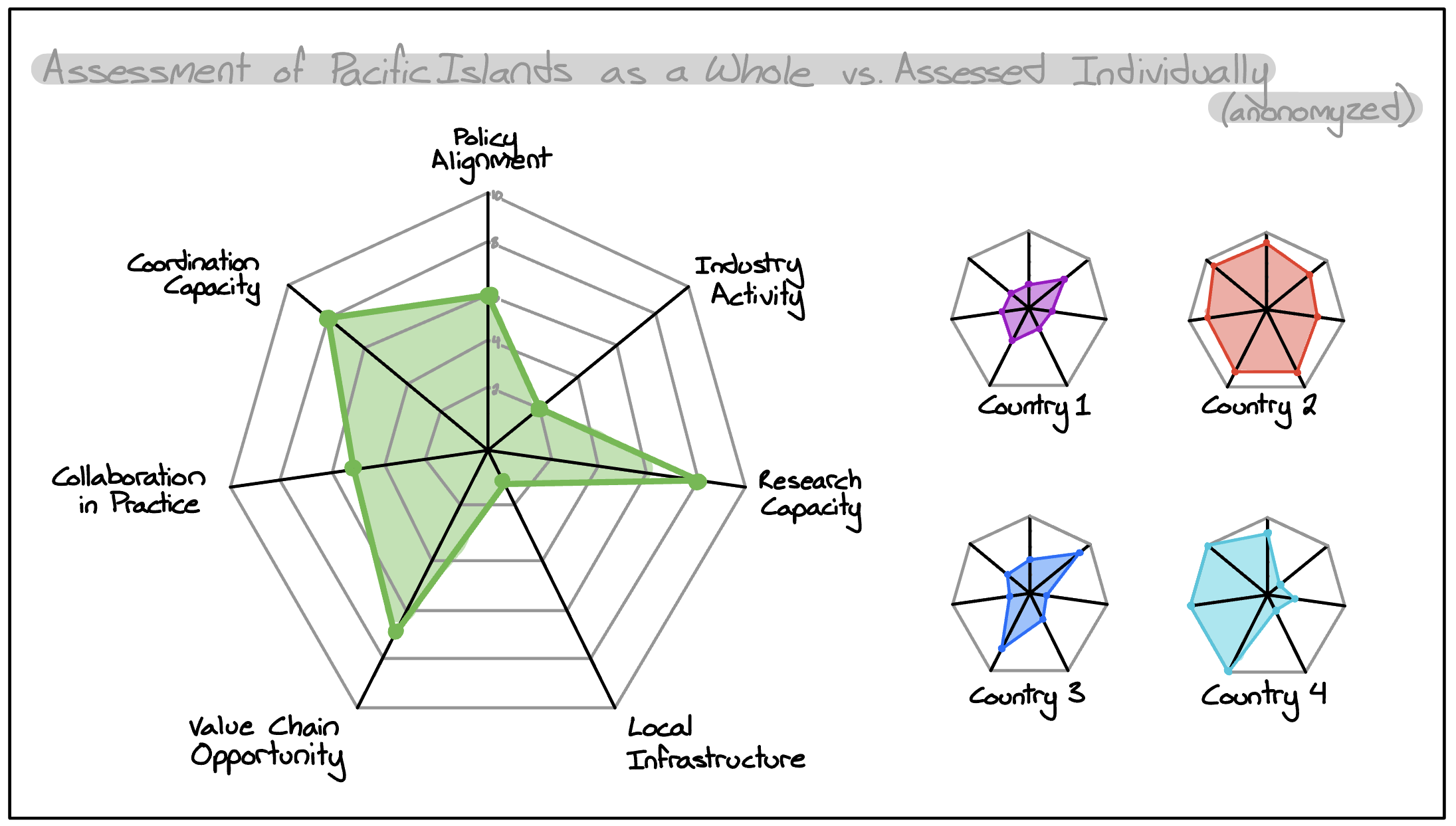
This high-level study surfaced meaningful trends, highlighting both why a shared regional cluster would be challenging, how each nation's readiness differs, and similarities in challenges and opportunities for collaboration. Future nationwide studies with deeper respondent pools would help determine specific development stages and priority actions for each country, but the initial deployment of this tool across the Pacific Islands surfaced many meaningful insights that can serve as jumping-off points for future studies and targeted ecosystem development efforts.
What the assessment found
In the Pacific Islands, responses were received from various region-as-a-whole perspectives and actors in individual nations. Perspectives ranged from investment managers at regional NGOs and funds, to national fisheries managers, to members of private fishing and processing companies. While numerical scores for each of the seven readiness dimensions varied significantly by respondent role and region, the qualitative comments behind each score surfaced parallel opportunities and challenges across the Pacific Islands.
There is immense opportunity. Across respondents, the sentiment was clear that the Pacific Islands region is the perfect untapped opportunity for better high-value utilization of seafood side streams, especially from Tuna. Currently, there is little to no utilization of side streams, but the overarching enabling structure is there:
The Pacific Islands Tuna RFMO is a global example of sustainable, collaborative fisheries management. There is MSC certification, strong limits on overfishing, and science-focused management. The structure is there to ensure that increased value creation from catch would not drive overfishing, and with such strong scientific management comes the scientific structure to explore value creation opportunities. Many respondents across the Pacific Islands cited their strong scientific institutions that could support full utilization efforts. Although many ranked research capacities on the lower side, this was due to lack of access to industry data. The scientific research capacity itself is very strong across the region.
Matching access to existing scientific resources could help accelerate efforts towards better side stream utilization. Further, there is a hunger for local community empowerment. To bring value and jobs from the tuna in their waters home to their communities. Several respondents also pointed to the underrepresented role of women and community-level entrepreneurs in seafood value chains as an area for targeted support.
The challenges and opportunities identified by the respondents are extremely interconnected.
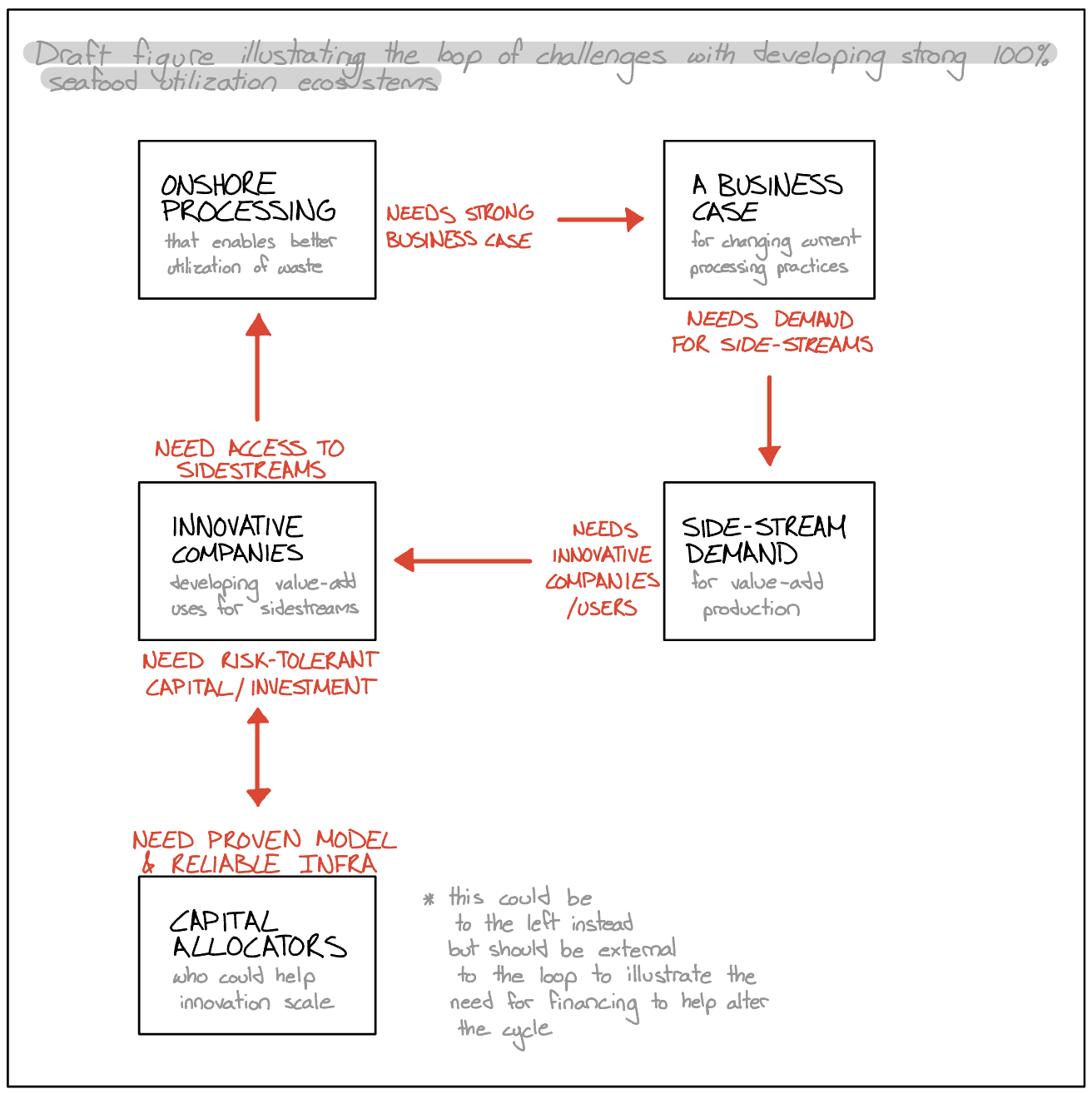
Cross-cutting themes illustrated by this loop of interrelated challenges that currently inhibit or stagnate seafood utilization potential include:
- Local processing bottlenecks. Multiple respondents across the Pacific Islands cited insufficient incentives for onshore and domestic processing as a barrier to local value creation and capture opportunities. Whole-fish and frozen export models, and international ownership of catch, in many nations' tuna fisheries create a lack of local access to byproducts for more sustainable and higher-value utilization. In some Pacific islands, local processing is more established, but in these situations, respondents still cite various challenges to be overcome to enable better side stream access, such as private ownership of side streams. The degree of challenge varies regionally, but the underlying problem is consistent: local users do not have access to the side streams.
- Fragmented side stream demand. For large companies to change how they handle Tuna side streams (currently tossed overboard or passed down the supply chain outside the Pacific Islands), they need to see a real business case: reliable demand for those side streams, which doesn't yet exist. If processing were to move onshore without substantial demand for the side streams, it could create local waste problems along with high costs to processors.
- Innovation challenges. To create reliable demand for side streams, there needs to be innovation. While there is certainly identified drive to innovate and create more value from fisheries across respondents' regions, it is difficult to do so without access. Respondents cited access to data about side streams as being nearly as limited as access to the side streams themselves. The scientific foundation is there, the innovative people are there, but it's not possible to create innovative end products from unknown side streams. Real innovation depends on access, which in turn depends on processing moving onshore and processors sharing more data: changes that require a genuine economic incentive or regulatory push.
- Lack of risk-tolerant capital. Respondents across investing, but also involved in local policy and industry, also repeatedly referred to a lack of risk-tolerant capital as a barrier. This capital is needed to create an example of success that could begin breaking this self-fulfilling cycle. Many previously funded projects have been short-lived, either failing to take off or running their course without follow-up, and donors have grown fatigued as a result. Many survey respondents called for investment of blended and impact capital in the region: capital designed to drive growth in entrepreneurship surrounding high-value full-fish utilization practices, rather than one-off projects. But investors need to see success to invest, and without risk-tolerant capital, success is hard to reach.
Collaboration to demonstrate success in private sector side stream utilization could have long-term benefits for the region. It could bring in capital, help innovation scale, drive processing onshore, and improve regional infrastructure, in turn attracting further investment.
With so many interrelated challenges, the hardest part may simply be knowing where to start. But it is possible. This cycle of challenges reflected so clearly in the Pacific Islands' responses to the Cluster Readiness Assessment is actually not unique to the region. The Iceland Ocean Cluster has seen similar cycles in emerging clusters it has supported around the world, including its own early years. Change is hard when a system already works “good enough,” and steady-state systems often need a real push to improve, even one as well-managed as the Pacific Islands' tuna fishery. But the benefits could significantly outweigh the costs: value capture from Pacific tuna could increase drastically, creating value for processors, fishers, and local producers. It could bring long-term investment and infrastructure to the region, with benefits outside of the seafood industry, increasing the economic resilience of resource-dependent island nations. With the right push and collaborative action, the Pacific Islands could reach a new steady state, where collaborating national clusters help improve the region's fishery value capture and economic resilience.
Think global, act local
Collaboration and pooling of resources within nations and across the Pacific Islands could help to develop, strategically fund, and showcase an example of high-value utilization from Pacific Tuna side streams. Collaboration to create one proven technology from the region could be the Pacific Islands' Kerecis equivalent. It could catalyze the sector's growth and help to break the cycle discussed above.
On specific targeted goals, collaboration is strong across the Pacific Islands and at national levels. Many respondents stated that their fisheries management organizations excelled in collaboration and coordination of different organizations to achieve good management practices. This just hasn't yet been translated into utilization practices. Past projects of this nature often competed for resources and did not facilitate a collaborative environment. What if one collaborative innovation project could help individual utilization clusters take off across the Pacific Islands? Coordinating bodies like the FFA could help organize this, using survey responses to map out where processing infrastructure, side-stream access, reliable electricity, scientific insight, and innovators are strongest across the region, since no single country holds every piece. Developing and showcasing one example could build excitement and momentum for 100% utilization across the Pacific Islands, catalyzing the region's growth and creating the conditions for strong clusters to take hold.
The path forward isn't one shared cluster. It's proving the model and then letting the region's existing collaborative strength carry it outward.
Exciting collaborative action is already happening across the Pacific Islands.
With the Iceland Ocean Cluster and the Global Ocean Clusters project · How to run the ecosystem readiness assessment