About this chapter
The goal of this chapter
To craft and share the story of your leadership, your ecosystem and its 100% work, to inspire and engage your wider ecosystem and turn distinct activities into a movement.
- Tell the story in person, with places and products people can see and touch: tell the stories of your 100% Champions, to inspire and engage your wider ecosystem and turn distinct activities into a movement.
- Use visual storytelling, from a single picture of the whole idea to your own value machine and 100% wheel.
- Understand the power of storytelling and how to tell impactful stories: craft and share the story of your leadership, your ecosystem and its 100% work, and build your own presentation with the storytelling guide.
What you'll learn, in three parts
Tangible storytelling in person
Why this is important: Walking visitors through a place like the Iceland Ocean Cluster House tells the story in things they can see and touch. Real examples of fish being used in full show what is possible, and shift attitudes in a way that statistics alone rarely do. Telling the stories of the entrepreneurs, researchers and companies already doing 100% work inspires others to follow, turning individual successes into a movement.
Go to part 1 ↓Visual storytelling: a picture says a thousand words
Why this is important: Visual storytelling is incredibly powerful, especially when you are communicating big, complex ideas: a single image can show in seconds what pages of explanation struggle to get across.
Go to part 2 ↓Storytelling for impact: crafting your story
Why this is important: Storytelling and messaging are so important: the stories of your leadership, your ecosystem and the amazing 100% work already happening are how you inspire and engage your wider ecosystem, and go from distinct activities to a movement. Showcase the opportunity of full utilization in your ecosystem, from global examples of value creation to the volume available and its potential. And while Iceland's 100% Fish journey, one fish going from about $12 to about $5,000, inspires an audience, your own story, told with the storytelling guide's eight steps, is what engages them in what is possible where they are.
Go to part 3 ↓
Learn and apply
Part 1 · Tangible storytelling in person
The house as a storytelling tool
The Iceland Ocean Cluster House is more than a place to meet. Walking visitors through it, stop by stop, tells the story of the circular and blue economy in things they can see and touch.
The building's history
The story starts the moment you walk in, with the building itself. It was once a fish processing facility, and it also housed rope repair and other harbor trades. Today it has been reimagined: upstairs is the Iceland Ocean Cluster House, and downstairs is a food hall. The building is itself a circular economy story, a working space given a new life rather than torn down.
The harbor location
The house sits right by the harbor, and that matters. From here we can point to what is happening in the harbor as part of the blue economy. The location gives the cluster a physical anchor, and it places the house at the heart of many different blue economy activities happening around it.
The shipping containers
Two parts of the house are built from old shipping containers. These once carried goods across the Atlantic, which matters enormously to Iceland as an island nation. The container revolution allowed Iceland to take full part in the global supply chain and economy. Our container no longer ships anything. It is now part of the upstairs meeting and dining space, another tangible way to show what the circular economy means.
Artists and different minds
Artists have shaped many elements around the house. This is where we introduce a first key idea: different kinds of minds bring fresh ideas to the fisheries sector and the blue economy. Diversifying perspectives is part of how value gets created. Overhead hang lights made from old fishing net buoys, cast in ceramic.
The cod skin lights
In the entrance hang lights made from dried Atlantic cod skin. They carry on the story of art, and they make a clear point. Cod skin was once thrown away. Now it is dried and made into something functional, beautiful and valuable: each light sells for more than $1,000.
There is an environmental side too. Skin sent to landfill breaks down and produces methane, a very potent greenhouse gas driving climate change. For visitors new to the idea of 100% utilization in seafood, these lights are a first, memorable example. Being memorable is the point: it is what makes the message stick.
The heritage wall
Walking through the corridors, visitors pass a wall of heritage photos from Iceland's fisheries. Heritage cannot be overlooked, in storytelling or in helping people connect modern innovation with where it comes from. The circular economy is not a new idea. It has been reborn. For Iceland's population it was always a necessity.
Here we tell the history and development of Iceland's fisheries, including the role of women in the sector. The key message is that this resource was hard won, and none of it should be wasted.
The salmon leather jacket
In the small kitchen hangs a jacket made of Atlantic salmon leather. It recalls the day a fashion entrepreneur arrived at the house wearing a full suit of salmon skin. It is a tangible example of how something from the seafood sector can look completely different when reimagined, and it ignited the imagination of Iceland's textile sector.
Here we explain how fish skin tanning works. Skin that was once thrown away has a value of around $50 once tanned. That brings together both sides of the story: the environmental benefit of not wasting, and the economic benefit of not wasting.
The product table
Real products on the market, made from parts of the fish once thrown away, convince people more than any argument. Here is a table of these products: hover over or tap a dot for its story, or step through the stories in order.
The stories start with the low-hanging fruit and move up the value chain. They stay with one species, Atlantic cod, as the through-line: it is Iceland's highest-volume whitefish catch and still its highest-value seafood export, so it makes a clear story. Products from other species on the table come later.
Dried cod heads
We start with heritage. Iceland has a long tradition of drying fish as a snack, called harðfiskur, or hardfish. The know-how and culture of drying fish are built into this fishing nation. Cod heads, though, were never part of Iceland's food culture.
They are part of the food culture in countries like Nigeria, where dried fish heads are a base for soups and stews. So the opportunity was not new processing or big investment. It was applying existing know-how to a new market that wanted the product. That is why we call it low-hanging fruit: it could be done quickly, without big change.
Dropi
Dropi means “drop” in Icelandic, and we always link a product to its language and provenance. It is another low-hanging fruit. The wives of fishermen in the Westfjords asked how to do more with less and earn better margins from the catch. Their answer: land the livers and do something with them.
Using small-scale, fairly low-tech methods, they cold-press cod livers into a high-end cod liver oil. Much of their success comes from marketing and packaging: the oil is sold as pure Icelandic cod liver oil in attractive bottles. It shows how other minds, like marketing and branding, are key to creating value from seafood.
Lýsi
Compare Dropi with Lýsi, which has been producing cod liver oil at large scale since 1938. Lýsi serves a different market, large-scale international export, with a range of products shaped around each customer segment.
Lýsi plays cleverly on heritage too. The name comes from an old Icelandic word for light, because cod liver oil was once used to light lamps. A product's story builds customer loyalty and connects people with what they buy.
Fish skin leathers
The table holds fish skin leathers tanned from many species. Some come from Iceland's wild-caught fisheries, such as Atlantic cod, wolffish and spotted wolffish, and increasingly from farmed Atlantic salmon. Alongside are products made from them.
When high-quality tanned skin goes into a high-quality fashion item, value rises all along the chain. Internationally, well-known brands such as Nike and Puma have used fish skin leather in some products. Linking seafood heritage to familiar names makes the idea feel accepted, not niche.
Feel Iceland collagen
Feel Iceland was founded by people who did not come from seafood but saw, partly through the cluster, the opportunity in collagen peptides from fish skin. Collagen peptides are hydrolyzed, or broken-down, collagen chains the body can absorb, and they can be building blocks for protein. The market for them is huge.
The founders built a high-quality collagen brand for the nutraceutical and supplement market, packaged it beautifully, and sold it in Iceland and abroad.
COLLAB
Then comes the human part of the story. The founder of Feel Iceland, building the business while looking after her family, relied on energy drinks and realized most were not very healthy. So she created her own caffeinated energy drink with fish skin collagen, COLLAB, made with Ölgerðin, Iceland's leading beverage maker. It reimagined the same ingredient for a very different customer segment, showing the range of ways to use, market and package it.
Cod enzymes
In many countries, fish guts, or viscera, are seen as very hard to handle, especially outside cold temperatures, because their enzymes break down quickly. In Iceland, an enzyme called trypsin is extracted from Atlantic cod guts. Trypsin breaks down proteins, and it is used in some novel products.
One is ColdZyme, a spray used in the throat when a cold is starting. Another is Penzim, a skincare and wound-healing gel that draws on trypsin's biological properties. Here we point to the science, the social value and the economic value, always including what the products cost on the market.
Kerecis
Higher up the value chain is the biomedical field, with wound dressings made from Atlantic cod skin by Kerecis. The company was founded in a village in the Westfjords by people who knew both the seafood sector and the medical device sector, and it reimagined how fish skin could be used.
We explain the biology. The skin graft treats burns and diabetic sores by acting as a scaffold for healing, and it carries a lower risk of disease transmission than traditional products such as pigskin. After FDA clearance and bringing in expertise, Kerecis was sold for $1.3 billion in 2023. That economic win comes with real social value, from a part of the fish once discarded on the processing floor. It is a very powerful message.
Why tangible products convince
Showing people real products on the market, from your own ecosystem or internationally, is the best way to convince them. It goes beyond explaining that full utilization is a good idea, and beyond quoting numbers: people can hold the products and look at them.
Each story combines heritage, social and environmental value with a price tag, which ties it to the real business of full utilization. That is why, as an ecosystem leader, you need to know the stories of the founders and products, and how the science fits in. You do not have to be a scientist, but you should understand the key points of why research-based products work.
Ten companies100% Champions from Iceland and around the world →
Five startups and five large seafood companies: how each turns side streams into products, and where its products sit on the value pyramid.
Let founders tell their own stories
The ecosystem leader and cluster team play a vital role in bringing these ideas together, not as single products but as an ecosystem of 100%. Yet hearing directly from the founders and entrepreneurs is especially powerful.
That is another reason a physical house or space matters. Invite founders to tell their stories to the fisheries industry, to potential investors and to potential buyers. Building strong relationships with founders is a central part of your role as ecosystem leader.
For an example, read AlaSkins founder Sara Erickson's own story of building a 100% Fish business in Alaska.
Prepare your 100% champion stories
Every company on the table is a 100% champion. Lifting up and showcasing them is part of the cluster's role, because they are the examples that convince people this idea is promising. To prepare your own stories:
- Find who is already doing this in your ecosystem, from low-hanging fruit to further up the value chain. Most likely, someone is.
- Speak to the founders. Understand their story, their challenges, what they are creating, and how they market and talk about it.
- Ask why they chose to create value when others may not, and what they might want to do next.
- Explore how you, as ecosystem leader, can help lift up what they are doing.
- If no one is doing this locally yet, draw on international examples, like those here from Iceland and across the Sister Ocean Cluster network.
- Build your own table of products and ideas.
In Oregon, the cluster put together a box of local full-utilization products from the seafood and seaweed sectors. They take it to events as a traveling table of ideas and products to help tell this story.
Further reading · 100% Fish100% Fish: stories that change how we think about seafoodRead
Key messages from the 100% Fish book:
- Stories change minds. Real examples of fish being used in full show what is possible, and shift attitudes in a way that statistics alone rarely do.
- Every part has value. Heads, skins, frames and other side-streams can become food, health, cosmetic and medical products, creating value from what was once treated as waste.
- Value creation drives change. When companies see real products and real income from by-products, the way the industry thinks about seafood starts to change.
- Showcase your pioneers. Telling the stories of the entrepreneurs, researchers and companies already doing 100% work inspires others to follow, turning individual successes into a movement.
Part 2 · Visual storytelling: a picture says a thousand words
Graphics get the message across simply, clearly and attractively, so people understand it at a glance. Two graphics do this especially well.
Visual storytelling is incredibly powerful, especially when you are communicating big, complex ideas. A single image can show in seconds what pages of explanation struggle to get across, and people remember it long after the details of a talk have faded. Iceland's Incredible Fish Value Machine does exactly that: the whole idea of 100% Fish, one fish, many products and zero waste, in one picture anyone can understand at a glance.
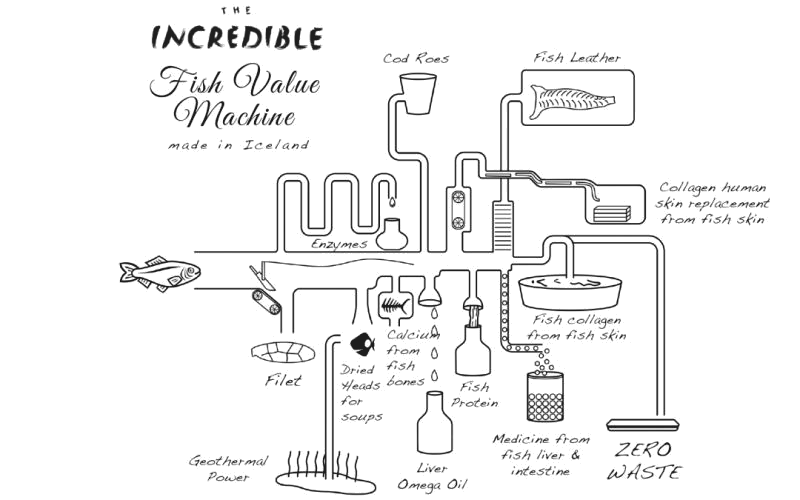
This image tells a very simplified story of zero waste for Atlantic cod, showing all the different ways the fish can be used. It is drawn in an artistic style and an easy format that people can take in at a glance. Below it, a tool lets readers make a first design of their own Incredible Fish Value Machine for their own species.
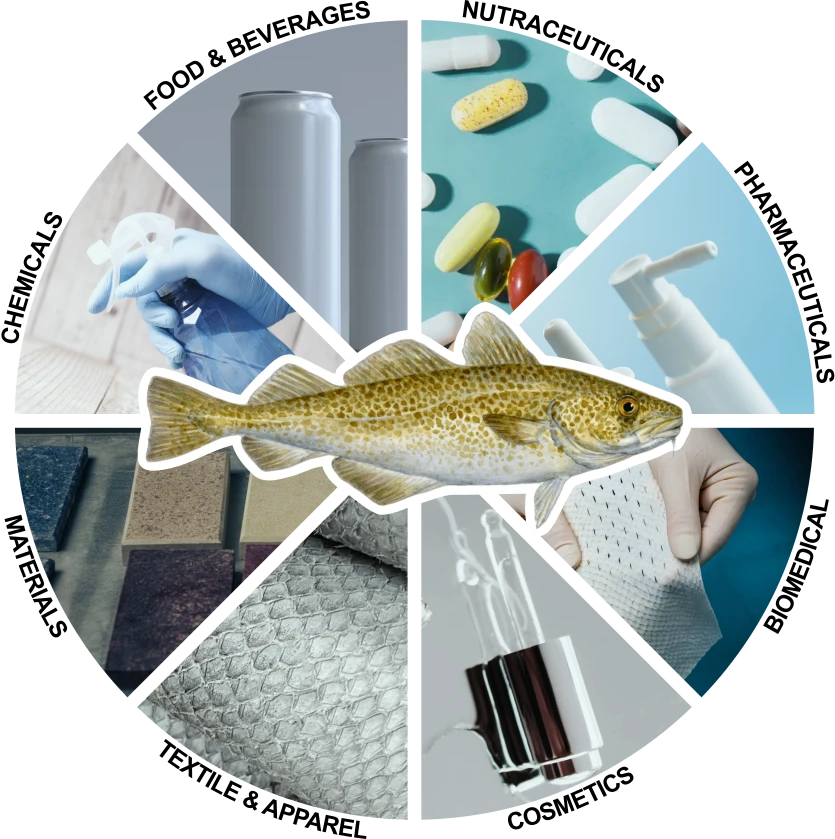
The 100% Fish wheel tells the same story another way: one Atlantic cod at the center, surrounded by the many products made from it in Iceland.
The wheel shows, in a single image, all the customer segments, product types and sectors that can now be linked to seafood. It is a story of diversity: the blue economy now reaches far beyond fishing and fish processing. That diversity is what makes the ecosystem resilient, and the wheel makes all those possibilities visible at once.
Dos and don’ts of impactful presentations
For your presentations and their slides, so they enhance your storytelling rather than distract from it.
- Use highly visual slides that are simple and clean.
- Use images as storytelling support devices.
- Have simple, clear messages and key numbers for the environmental or economic opportunity, or the biomass volume. Make sure these numbers are based on fact or, if not, state that they are estimates.
- Always consider that your audience will only take away one or two key messages from your talk, so be clear on what they should be.
- Crowd your slides with text.
- Try to tell too many stories in one sitting.
- Try to cram too much high-impact information in all in one go: let the numbers and examples land.
- Forget to mention who you are, why it is you telling this story, and why now.
- Read your slides word for word: they are there to support what you say.
- Fill your talk with jargon or acronyms your audience may not know.
- Run over your time: rehearse, and time your talk.
- Leave the technology to chance: test your slides, sound and connection beforehand, and have a backup.
Part 3 · Storytelling for impact: crafting your story
Storytelling and messaging are so important: the stories of your leadership, of your ecosystem, and the amazing 100% work that is already happening or is emerging. This chapter deals with crafting your story:
- How do you inspire and engage your wider ecosystem?
- How do you showcase the 100% work of amazing entrepreneurs, researchers and industry?
- How do you go from distinct activities to a movement?
It is important to showcase the opportunity of full utilization in your ecosystem, drawing on global examples of value creation as well as the volume availability and potential for value creation.
What makes a story powerful
Eight ingredients, drawn from research on how stories move people to act, with an example of each from the 100% Fish story.
A real story arc
Cause and effect, over time, happening to someone. Without these, it’s just information.
Fish processing plant, then rope repair, now the Ocean Cluster House.
A person at the center
People are moved most when they identify with a character and see themselves in the story.
The fishermen’s wives in the Westfjords who started Dropi.
Vivid and real
Concrete, sensory detail draws people in. The more real a story feels, the deeper they’re immersed.
Products on the table that visitors can pick up and hold.
One example beats a statistic
A single, specific case stirs more than a table of numbers. Attach the number to the thing.
One cod skin light, once landfill, now worth over $1,000.
Don’t oversell
When the push to persuade is too obvious, stories backfire. Let the story do the work.
Invite founders to tell their own stories, in their own words.
Shape the emotional arc
Move people from a problem to its resolution, rather than holding one note all the way through.
Skin thrown away, rotting into methane, then a $1.3 billion wound-care company.
Use a simple framework
The story spine: once upon a time… every day… until one day… because of that… until finally…
Use it to prepare your own 100% champion story.
Tell it honestly
Stories are persuasive, so they carry responsibility. Help people understand, not just agree.
Real prices, real products, and the science explained simply.
Why it works
Stories carry people with them
When people are immersed in a story, their attitudes shift to match it and they question it less.
Stories change what people do
Across dozens of studies, stories shifted beliefs, attitudes, intentions and behavior, with effects that lasted.
Sources: Green & Brock (2000), Journal of Personality and Social Psychology · Braddock & Dillard (2016), Communication Monographs · Oschatz & Marker (2020), Journal of Communication · Dahlstrom (2014), PNAS · Small, Loewenstein & Slovic (2007), Organizational Behavior and Human Decision Processes · Nabi & Green (2015), Media Psychology · Rotmann (2017), Energy Research & Social Science
Crafting your own inspiring presentation
Iceland's 100% Fish journey shows how one fish can go from about $12 to about $5,000. Use that story to inspire your audience, then tell your own: your ecosystem works with different species, markets and innovation, and is probably earlier on the journey.
In practice
Adapted for their own ecosystems
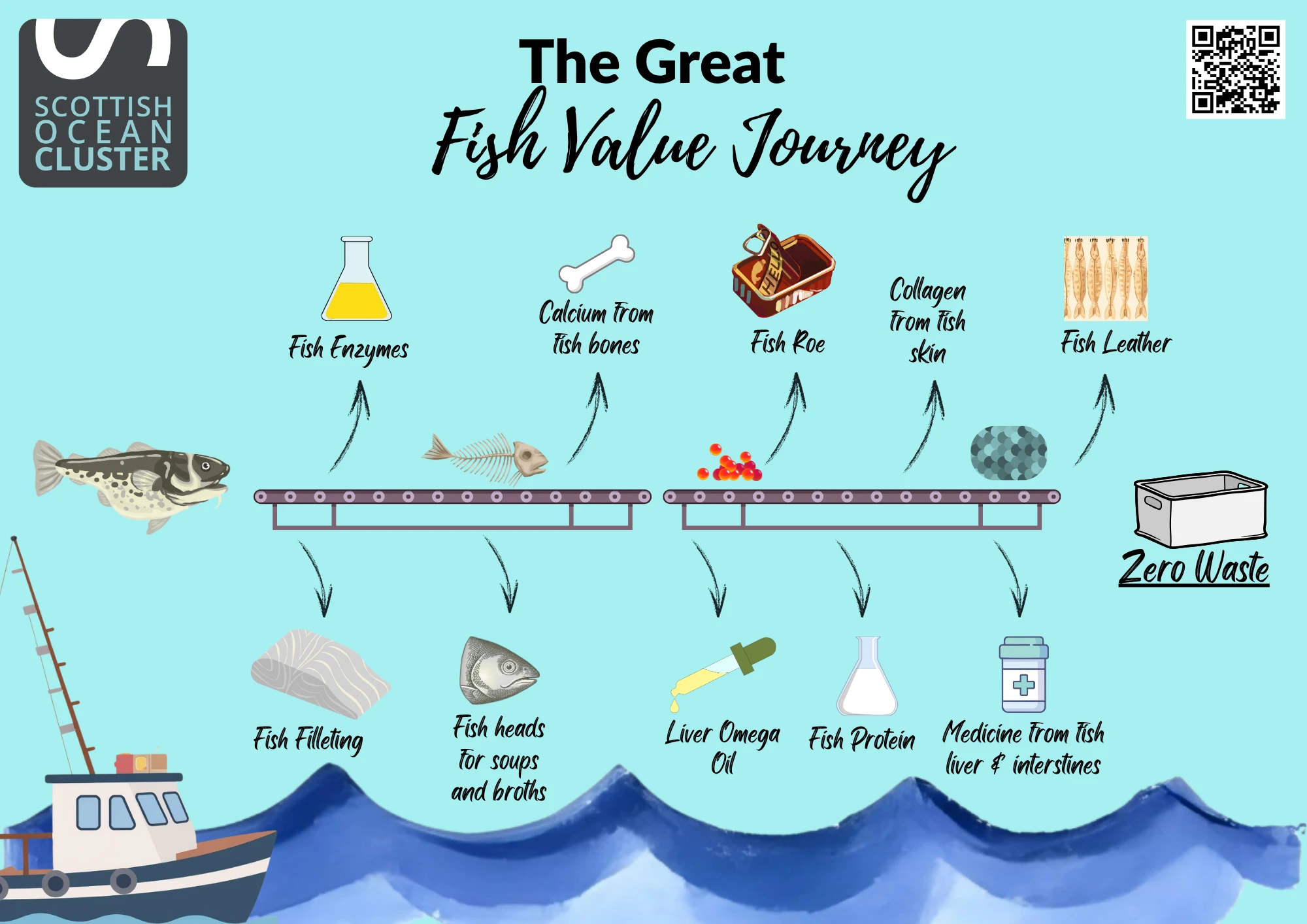
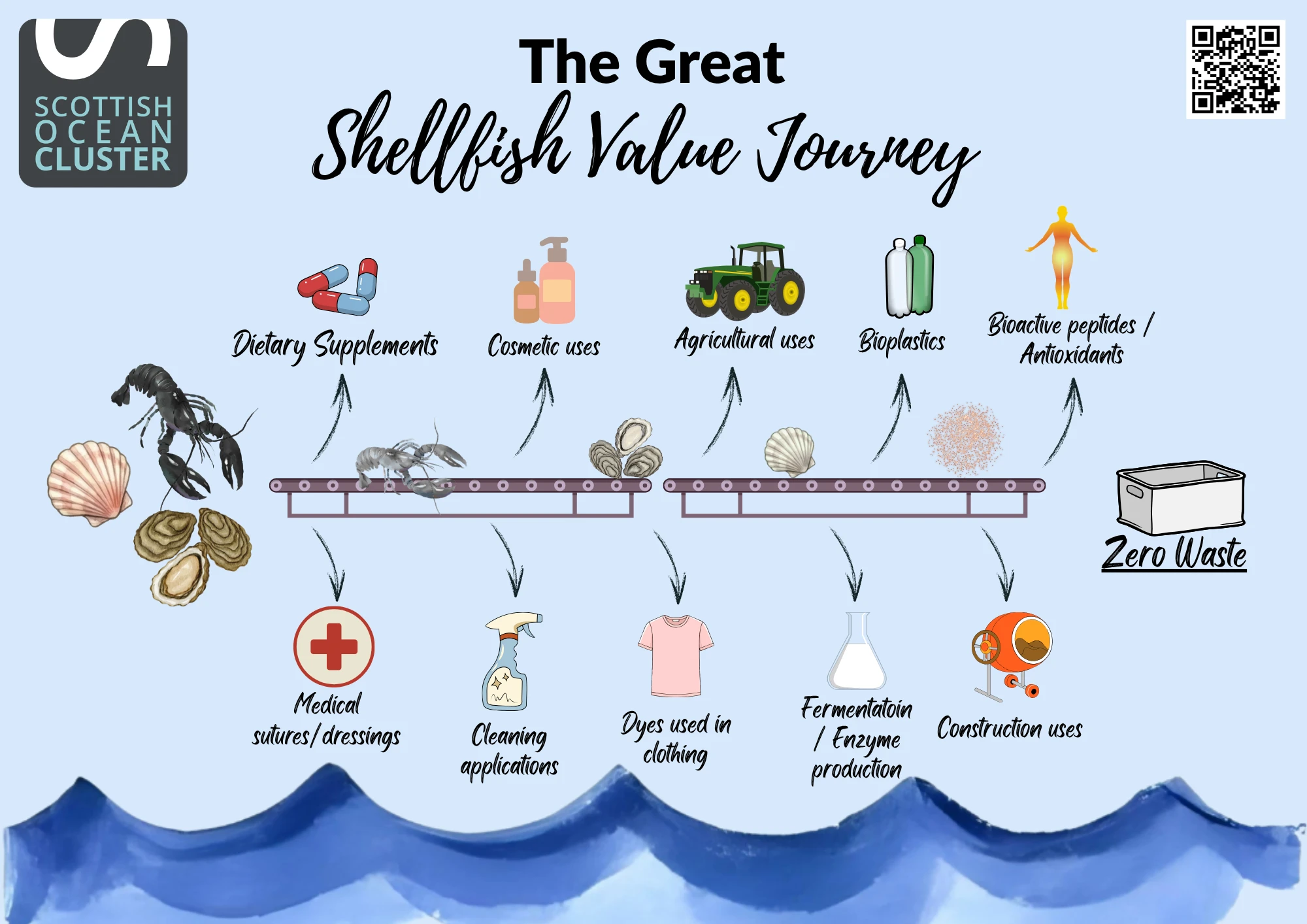
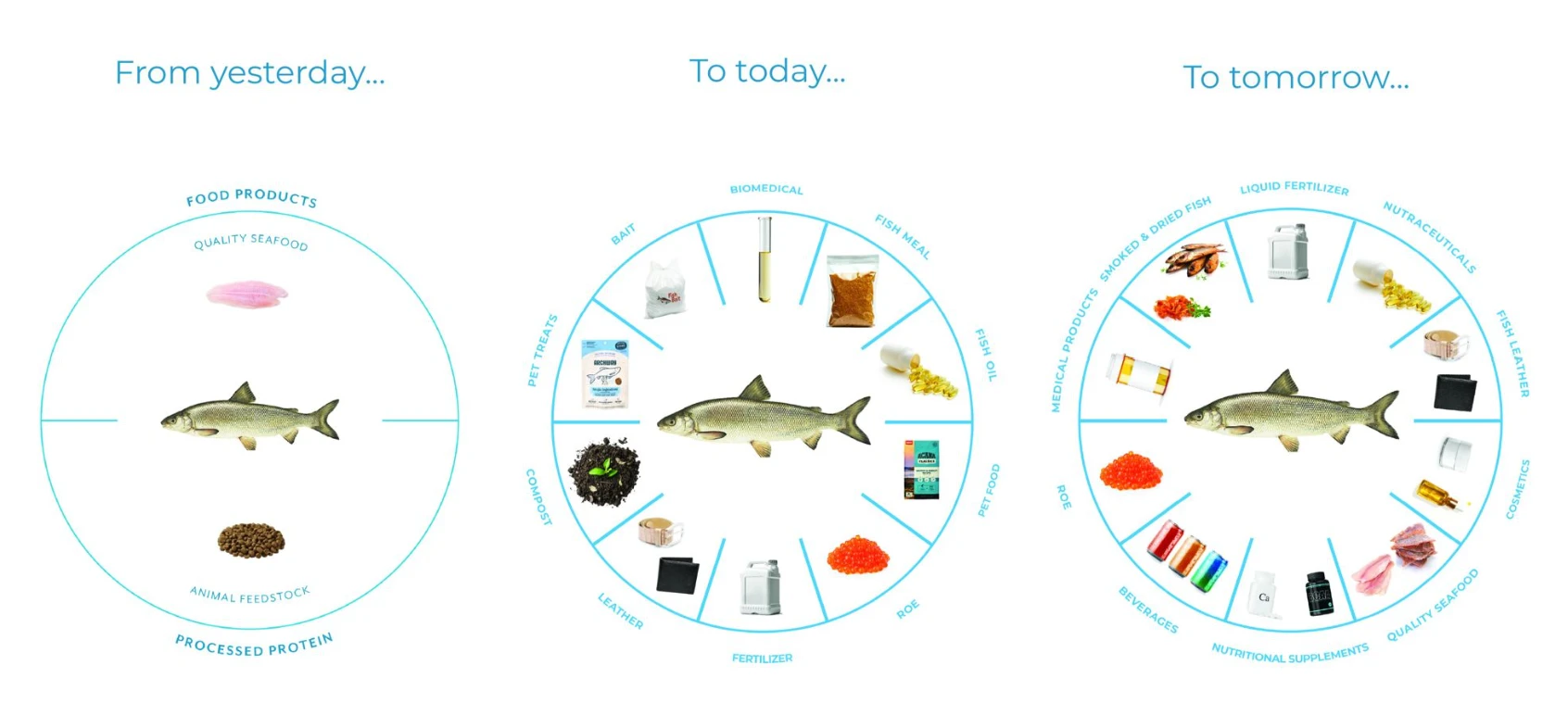
Sister Ocean Clusters and 100% Fish initiatives around the world have now adapted this kind of visual storytelling for their own unique ecosystems:
Learning from Oregon
Reflection · Oregon Ocean ClusterBuilding a cluster around a story everyone can buy intoRead
The Oregon Ocean Cluster grew out of the Oregon Coast Visitors Association, a tourism body rather than a seafood organization, and that shaped how it told its story. Instead of opening with cluster terminology, it started with a problem people already cared about: seafood landed on Oregon's coast was leaving the state, while as much as 90% of the seafood eaten locally was brought in from elsewhere. "Keep local seafood local" gave fishers, processors, chefs, policymakers, environmental groups and consumers each their own reason to join the same conversation.
For other ecosystem leaders, the lesson is that storytelling is a convening tool, not just a communications tool. Oregon spoke to each audience in its own language, took the message along the coast in person, put local seafood on the plate, and gave the ecosystem a place to meet at its annual Blue Foods Forum. That story has carried 100% Fish into policy discussions and won broad support; the next step is turning that momentum into infrastructure, products and businesses.
Stories change minds
- Make it tangibleWalk people through things they can see and touch, as at the Iceland Ocean Cluster House. Real products, from dried cod heads to Kerecis, convince more than any argument: know your 100% Champions’ stories, let founders tell their own, and share them with the Iceland Ocean Cluster.
- Show it in one pictureVisual stories like the Incredible Fish Value Machine and the 100% wheel make big ideas easy to grasp. Draw your own machine and wheel. When you present, keep your slides visual and clean, with one or two clear messages and key numbers based on fact, or stated as estimates.
- Craft your story for impactKnow what makes a story powerful, show the opportunity of full utilization in your ecosystem, and build a presentation around your own story, in eight steps or from your own script outline.
- Convene with your storyStart from a problem people already care about, speak to each audience in its own language, and take the message out in person. Adapt the visuals for your own ecosystem, as Scotland and the Great Lakes have.
Read the full TL;DR
In person, make the idea tangible. Walking visitors through the Iceland Ocean Cluster House, stop by stop, tells the story of the circular and blue economy in things they can see and touch: a former fish processing building given a new life by the harbor, old shipping containers, ceramic lights cast from fishing net buoys, lights of dried cod skin that each sell for more than $1,000, a wall of heritage photos, and a salmon leather jacket.
Tell the stories of your 100% Champions, the entrepreneurs, researchers and companies doing it: as the 100% Fish book shows, real products and real income from by-products shift how people think about seafood in a way statistics alone rarely do, and turn individual successes into a movement. Real products on the market convince people more than any argument: they can hold them and look at them. A table of them tells the story of Atlantic cod from the low-hanging fruit up the value chain: dried cod heads for markets such as Nigeria, Dropi's cold-pressed cod liver oil, Lýsi, fish skin leathers, Feel Iceland's collagen and COLLAB, its founder's caffeinated collagen drink, enzymes from cod guts, and the wound dressings of Kerecis, which was sold for $1.3 billion in 2023. Each story combines heritage, social and environmental value with a price tag, so know the stories of the founders and products and how the science fits in, and invite founders to tell their own, as Sara Erickson does for AlaSkins. To prepare your own champion stories, find who is already doing this in your ecosystem, speak to the founders, explore how you can help lift up what they are doing, draw on international examples if no one is doing it locally yet, and build your own table of products and ideas, as the Oregon cluster has with its traveling box. You can share your 100% champion stories, or the story of your ecosystem, with the Iceland Ocean Cluster.
A picture says a thousand words. Iceland's Incredible Fish Value Machine tells a simplified story of zero waste for Atlantic cod, and its 100% Fish wheel shows all the customer segments, product types and sectors now linked to seafood: the diversity that makes the ecosystem resilient. Visual stories like these make big, complex ideas easy to grasp and remember. Use them to inspire your audience, and draw your own with two tools: an incredible value machine for your species and its potential products, and a 100% wheel of the types of products in your ecosystem. When you present, use simple, clean, highly visual slides, with images as storytelling devices and clear messages and key numbers, based on fact or stated as estimates: your audience will take away only one or two key messages, so be clear on what they are. Don’t crowd your slides with text, tell too many stories in one sitting or cram in too much at once: let the numbers and examples land, and say who you are, why it is you telling this story, and why now.
Stories change minds. Craft and share the story of your leadership, your ecosystem and the 100% work already happening, and showcase the opportunity of full utilization in your ecosystem, drawing on global examples of value creation as well as the volume available and its potential for value creation. Research on how stories move people to act points to eight ingredients of a powerful story: a real story arc, a person at the center, vivid and real detail, one example rather than a statistic, no overselling, an emotional arc from a problem to its resolution, a simple framework such as the story spine, and honesty. Stories carry people with them, and they change what people do, with effects that last. For more, watch David JP Phillips’s TEDx talk, “The magical science of storytelling”. Use Iceland’s 100% Fish journey, one fish going from about $12 to about $5,000, to inspire your audience. Then build a presentation around your own story: your ecosystem works with different species, markets and innovation, and is probably earlier on the journey. The Telling your 100% Fish story guide takes you through eight steps, and you can follow the prompts to build your own 100% script outline.
Sister Ocean Clusters and 100% Fish initiatives such as Scotland's and the Great Lakes' have adapted Iceland's visual stories for their own ecosystems, as in the Scottish Ocean Cluster's Great Fish and Great Shellfish Value Journeys and the Great Lakes 100% Fish team's wheels, from yesterday to tomorrow. Storytelling is a convening tool, not just a communications tool. As Oregon showed with “Keep local seafood local”, start from a problem people already care about, speak to each audience in its own language, and take the message out in person.