
Prioritization in action: shrimp side streams in Sisimiut, Greenland
How the 100% Prioritization Matrix Tool was adapted to compare ten ways of using shrimp processing side streams in a remote community.
At a glance
- Where: Sisimiut, Greenland, where shrimp processing generates large volumes of side streams in one location.
- What was compared: ten utilisation pathways, from low-value uses such as composting and incineration to higher-value bioproducts such as protein hydrolysates and chitin and chitosan.
- How the tool was adapted: weighted categories, an assumed level of processing in Sisimiut for each pathway, and an added assessment of community value.
- Highest-ranked pathways, with their weighted prioritization scores: protein hydrolysates (60), chitin and chitosan (55), incineration (51) and shrimp meal (44), best combined as an integrated biorefinery.
To identify the most promising valorisation pathways for shrimp processing side streams in Sisimiut, a prioritization matrix was used to evaluate each utilisation option based on its technical, economic, and contextual feasibility, alongside its potential to create value. The purpose of the prioritization matrix was to systematically compare the utilisation pathways and determine which options offer the highest potential. The matrix served as a decision-support tool to narrow down the range of potential opportunities and identify the most suitable pathways for further development.
This page describes the assessment methodology, presents the results of the prioritization matrix, and discusses the opportunities with the highest implementation potential.
Methods
A prioritization matrix was used to identify the utilisation pathways with the highest combined potential. Each pathway represents a potential utilisation route for shrimp processing side streams, ranging from low-value applications, such as composting and incineration, to higher-value bioproducts, including protein hydrolysates and chitin and chitosan.
The assessment framework was developed by students at the University of California, Berkeley (Haas School of Business), and evaluates utilisation pathways across six key categories:
- Side stream availability
- Side stream fragmentation
- Market attractiveness
- Capital intensity
- Infrastructure maturity
- Regulatory complexity
Each category was scored on a scale from 1 (least favourable) to 3 (most favourable). Scores were assigned based on findings from literature review, stakeholder interviews, and contextual considerations specific to Sisimiut and Greenland. To reflect the relative importance of each category, weighting factors were applied. Market attractiveness received the highest weighting (40%), reflecting its importance for long-term commercial viability. Side stream availability and side stream fragmentation were each assigned a weighting of 10%, due to high availability of biomass in one location, all pathways scored high. Capital intensity, infrastructure maturity, and regulatory complexity each received a weighting of 20%. The scores were visualised using radar plots to provide a systematic comparison of the feasibility of each utilisation pathway.
For each pathway, the prioritization assessment assumes one of two possible levels of processing in Sisimiut, depending on the characteristics and requirements of each utilisation pathway. The first level is local production, where the entire valorisation process takes place in Sisimiut. This is particularly relevant for pathways that generate products intended for local use, such as energy recovery through incineration. The second level is pre-processing in Sisimiut, where side streams undergo an initial processing step before intermediate products are exported to specialised facilities for further processing. This level reflects the current industrial context in Greenland, where advanced processing technologies and expertise are limited. The assumed level of processing for each utilisation pathway is shown in the table below.
| Utilisation pathway | Level of processing in Sisimiut |
|---|---|
| Biochar | Pre-processing |
| Biogas | Local production |
| Carotenoids | Pre-processing |
| Chitin and chitosan | Pre-processing |
| Compost | Local production |
| Incineration | Local production |
| Minerals | Pre-processing |
| Protein hydrolysates | Local production |
| Shrimp meal | Local production |
| Whole frozen shells and heads | Local production |
In addition to the six categories in the original framework, each pathway was assessed for its potential to create value for the community in Sisimiut. Community value creation was evaluated by considering the pathway's potential to generate economic, social, and environmental benefits to the community, as well as its ability to address needs identified during the community value analysis. This qualitative assessment complemented the prioritization matrix by ensuring that recommended pathways aligned not only with commercial feasibility but also with community values and needs.
Results
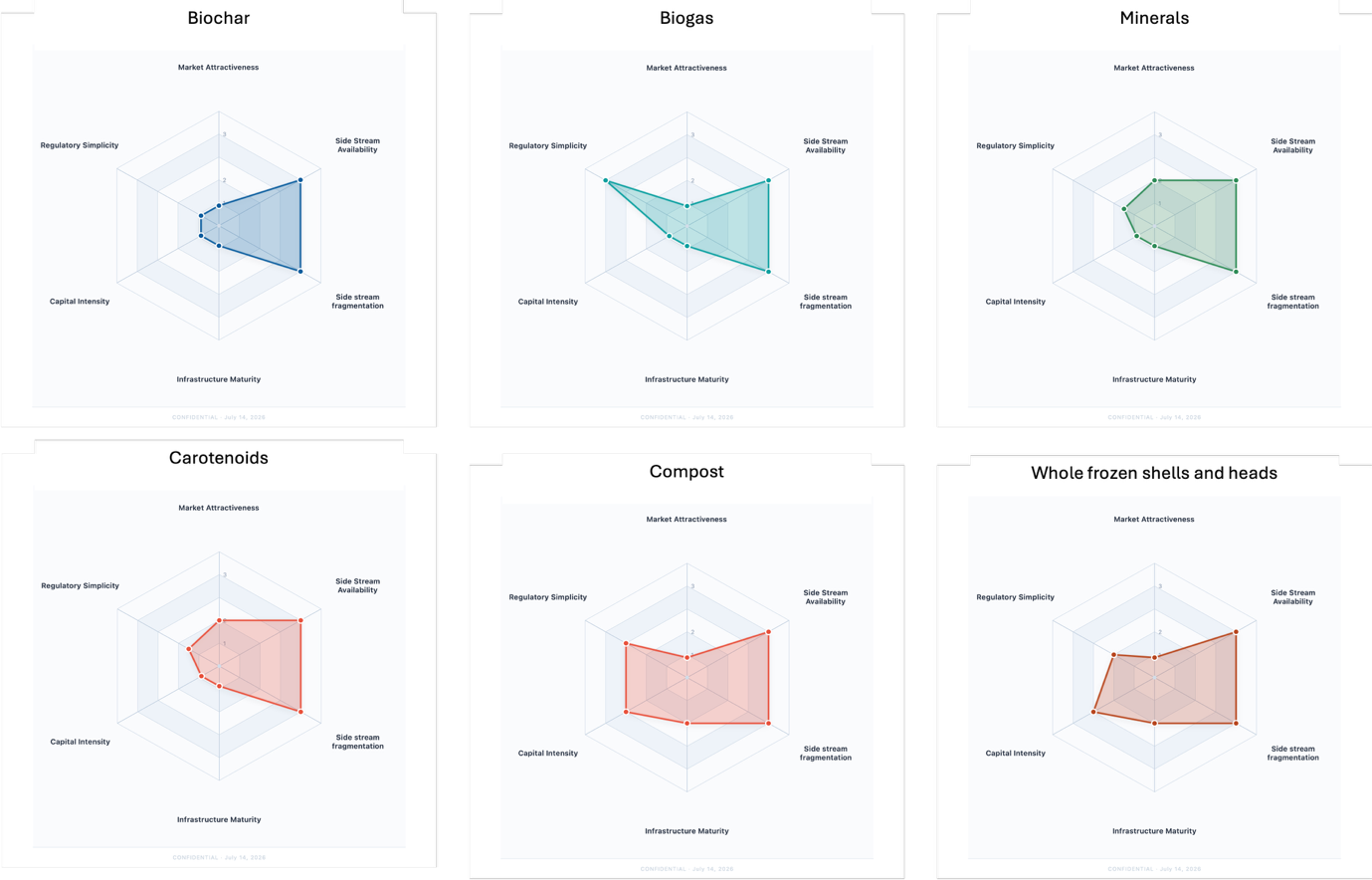
The prioritization matrix identified six utilisation pathways with low overall potential: Biochar (30), Biogas (30), Minerals (39), Carotenoids (39), Compost (43) and Whole frozen shells and heads (43). These pathways generally represent lower-value applications or face significant implementation barriers. Several require substantial capital investment in specialised infrastructure, depend on technological expertise that is currently limited in Sisimiut or Greenland, or remain at an early stage of technological development without widespread industrial implementation. As a result, although technically feasible, these pathways were considered less attractive for local valorisation under current conditions. However, compost and whole frozen shells and heads did show potential community value. Beyond economic value creation, these pathways show potential for small business opportunities and local production, increasing self-sufficiency in Sisimiut and Greenland.
Four pathways demonstrated the strongest balance between technical feasibility, market potential, and community value creation. The highest-ranked utilisation pathways were:
- Shrimp meal
- Incineration
- Chitin and chitosan
- Protein hydrolysates (industrial or food-grade)
Shrimp meal (44)
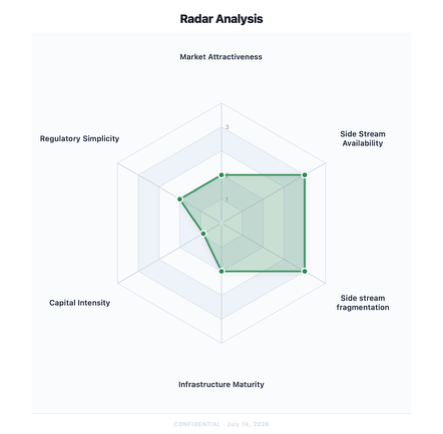
As in Ilulissat, shrimp processing side streams in Sisimiut could be utilised to produce shrimp meal. In an industrial-grade facility, the meal could be used as an ingredient in animal and aquaculture feed. If a food-grade processing facility were established, similar to the facility in Ilulissat, shrimp meal could also be produced for human consumption, enabling access to higher-value markets. The pathway benefits from established processing technology and a stable demand for protein-rich ingredients, making it a technically feasible utilisation option, for which a knowledge foundation is available in Greenland.
This utilisation pathway creates community value through increasing the proportion of value retained locally from the shrimp industry, and the establishment of processing capacity would create skilled technical and operational jobs.
Incineration (51)
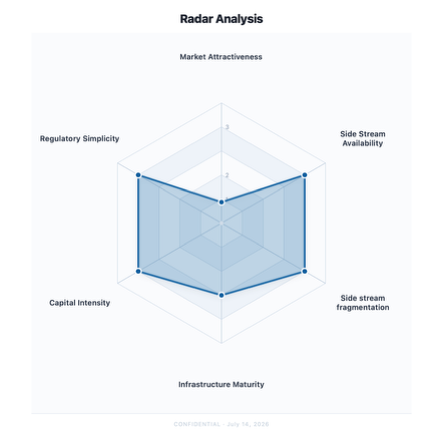
Although incineration is considered a low-value utilisation pathway, it received a high prioritisation score due to strong overall feasibility in Sisimiut. An incineration plant is already located just outside the village, allowing shrimp side streams to be utilised with relatively limited additional infrastructure. Implementation would primarily require dewatering of the biomass and transportation to the facility.
The energy recovered through incineration could be used to supply heat or electricity to other processing operations, contributing to a more circular utilisation system. However, the plant's capacity to accept shrimp processing side streams remains uncertain. The facility has a daily treatment capacity of 70 tonnes of waste, which may be insufficient to process the entire annual volume of shrimp side streams. Consequently, incineration is unlikely to represent a stand-alone solution due to its low-value creation but could provide an effective outlet for residual biomass remaining after higher-value products have been extracted through a (cascade) biorefinery approach.
Although incineration creates relatively limited direct economic value to the community, it provides a relatively simple opportunity to reduce the volume of side streams discarded, while improving local energy security.
Chitin and chitosan (55)
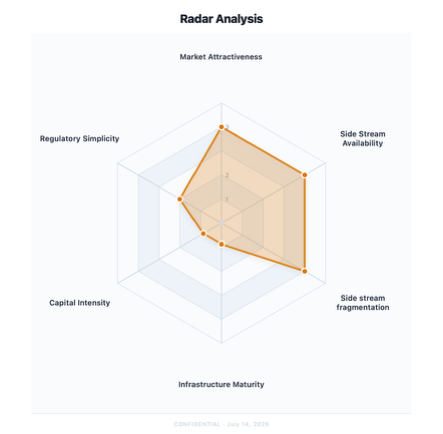
Chitin and chitosan production represents one of the highest-value valorisation pathways for shrimp shells and has a growing global market driven by a wide range of applications. Shrimp shells are an established commercial source of chitin, and the underlying extraction technologies are applied on an industrial scale.
The evaluation of this pathway considered a pre-processing stage in which shrimp shells are processed into an intermediate product suitable for chitin extraction. This approach could be integrated into a shrimp meal production facility equipped to separate shell fractions or an integrated biorefinery approach, enabling higher-value production. The feasibility of this pathway is supported by strong market demand, established commercial relationships with Primex, and the availability of a proven processing model in Ilulissat.
Local pre-processing for chitin and chitosan production would enable economic value creation in Sisimiut, rather than disposing processing side streams. The pathway would create skilled employment opportunities in processing and quality control, while supporting the development of specialised technical expertise within Greenland.
Protein hydrolysates (60)
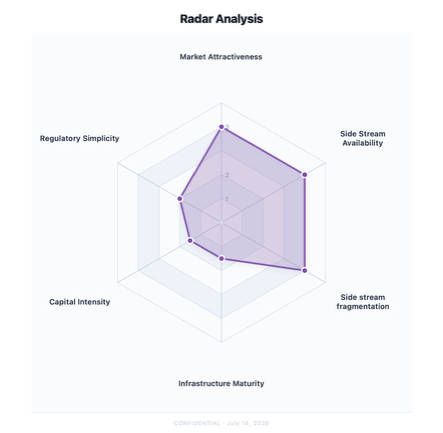
Protein hydrolysates achieved the highest prioritisation score, reflecting their strong combination of technical feasibility, market potential, and value creation. The global protein hydrolysate market is experiencing steady growth.
Two production scenarios can be considered. The first involves the production of industrial-grade protein hydrolysates, which requires lower processing standards and lower capital investment. This type of protein hydrolysate can be used in agricultural applications, including biofertilizers and biostimulants, as well as in animal feed. The second scenario involves the production of food-grade protein hydrolysates, which commands substantially higher market prices but requires compliance with food safety regulations and higher processing standards. A food-grade production facility could also manufacture industrial-grade hydrolysates, providing greater operational flexibility. This pathway can also be part of an integrated biorefinery approach.
Establishing production of protein hydrolysates would create skilled jobs in manufacturing, quality assurance, and process management in Sisimiut, while creating economic value from previously unutilised side streams. Furthermore, protein hydrolysates could be used in product development by local entrepreneurs.
Conclusions
The prioritization matrix demonstrates that the highest-ranked pathways combine technical feasibility with the ability to generate economic and community value. Protein hydrolysates achieved the highest overall score, followed by chitin and chitosan and incineration. Shrimp meal also performed well due to its technological maturity, existing market and integration possibilities. Together, these pathways represent the most promising opportunities for the utilisation of shrimp processing side streams in Sisimiut.
Importantly, the results indicate that these pathways should not be viewed as competing alternatives. Instead, they are complementary components of an integrated biorefinery approach, where side streams could be processed through a cascading approach to maximise resource efficiency and value creation. For example, proteins could first be extracted to produce protein hydrolysates, followed by the recovery of chitin and chitosan from the remaining shell fraction. The final residual biomass, unsuitable for further material recovery, could then be utilised for energy recovery through incineration.
This strategy would maximise the value obtained from shrimp side streams by generating multiple revenue streams from the same biomass. Beyond creating new revenue streams, this approach could contribute to local employment, strengthen technical capabilities within Sisimiut, improve resource efficiency, and increase the proportion of value retained within Greenland's fisheries sector. While further assessment is required to determine the optimal scale and feasibility of such a system, the prioritisation results suggest that an integrated biorefinery centred on protein hydrolysates and chitin extraction represents the most promising long-term strategy for Sisimiut.
Using the 100% Prioritization Matrix Tool · How to run the 100% Prioritization Matrix Tool