Prioritization in action: the Scottish Ocean Cluster
How the 100% Prioritization Matrix Tool identified Scotland's priority chains, and what on-the-ground engagement added.
At a glance
- Landings: dominated by Mackerel, Haddock, Cod, Scallops, and other whitefish.
- Candidate end products: Collagen Peptide, Gelatin, high-quality Fish Oil for human consumption, Trypsin Enzyme, and Calcium Carbonate (CaCO3).
- Priority chains identified: Calcium Carbonate and Fish Oil for human consumption.
- What came next: a stakeholder-first approach that surfaced five focus areas, with the matrix as an ongoing reference.
The 100% Prioritization Matrix Tool was developed and validated across two geographically, economically, and ecologically distinct regions using publicly available data, stakeholder interviews, and desk-based analysis. Scotland, a country with established seafood production and developing full utilization practices, was one of them. With the support of the Scottish Ocean Cluster, the tool identified the two highest-potential side-stream-to-end-product value chains for Scotland: Calcium Carbonate and Fish Oil for human consumption. Scottish Ocean Cluster leaders will now take this assessment further, using their on-the-ground presence to translate the tool's recommendations into action. As Section 2 explores, that on-the-ground presence revealed important local nuances that the external assessment could not fully capture, and ultimately shaped a different path forward than the matrix alone suggests.
Scotland is in the North Atlantic, its coastline defining much of its border. Seafood landings are dominated by Mackerel, Haddock, Cod, Scallops, and other whitefish, whose currently underutilized side streams can produce end-products including Collagen Peptide, Gelatin, high-quality Fish Oil for human consumption, Trypsin Enzyme, and Calcium Carbonate (CaCO3). The assessment surfaced opportunities and challenges associated with each. The concentration of local processing drives specific utilization opportunities, high disposal costs create strong economic incentives for valorisation, and the regulatory landscape shapes which chains are viable in the near term.
Section 1: Scotland's assessment
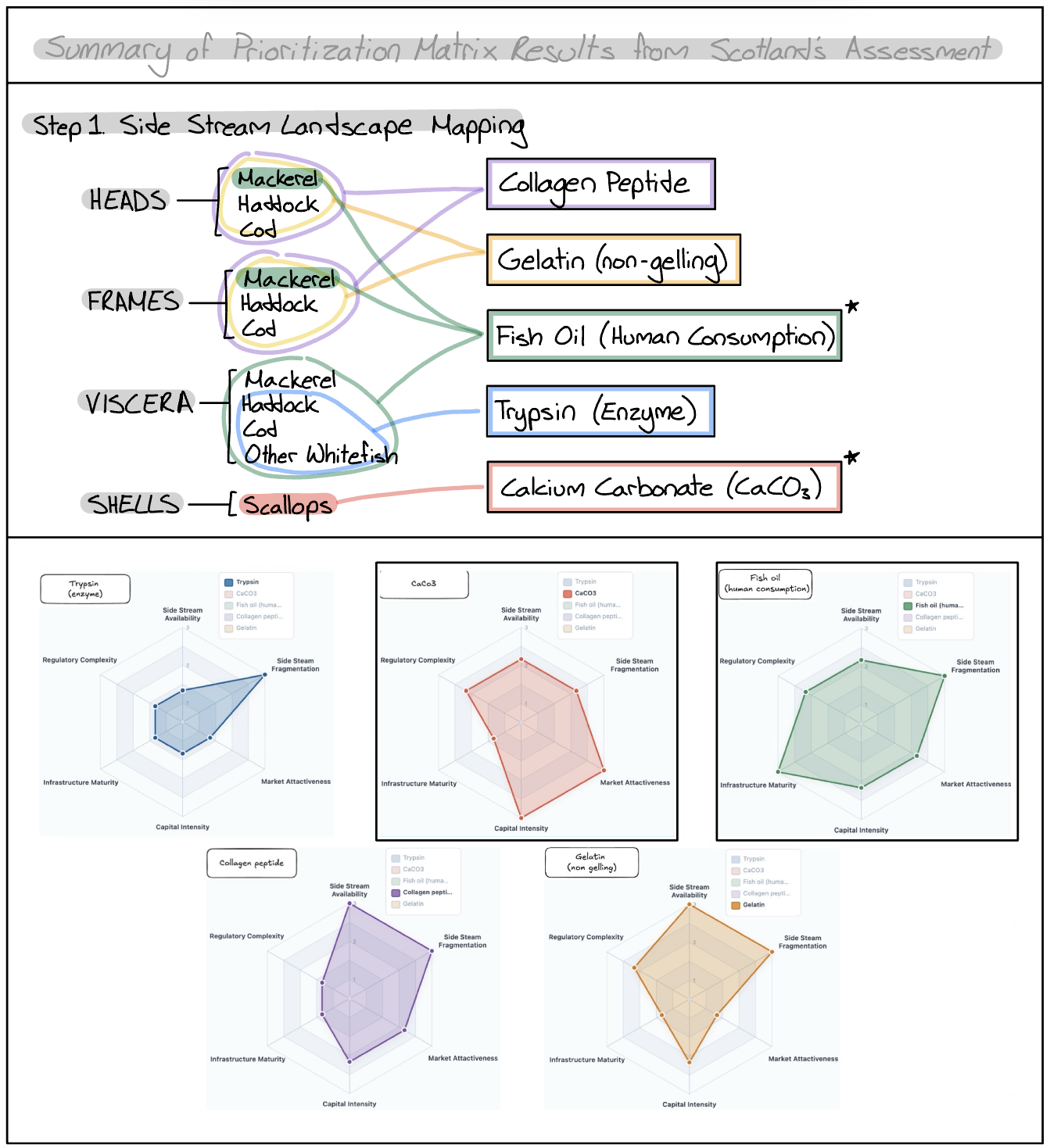
The 100% Prioritization Matrix, used in collaboration with the Scottish Ocean Cluster, assessed the opportunity of Scotland's potential side-stream-to-end-product value chains. The first step was mapping side-stream types and species to the high-value end products each could support. This mapping was conducted using publicly available landings data, UK-wide market sources, and local stakeholder engagement: a rigorous starting point that reflects the landscape at a high level. As with any externally conducted assessment, the full texture of local industry knowledge, regulatory nuance, and stakeholder relationships can only be captured by those embedded in the ecosystem itself. That is precisely what makes this tool most powerful in the hands of local leaders.
Side-Stream Availability
Measures the volume and consistency of usable side streams. A high score indicates year-round, consistent volume with low export leakage.
In Scotland, Collagen Peptide and Gelatin, produced from heads and frames of Mackerel, Haddock, and Cod, scored highest in side-stream availability due to their onshore processing. Whitefish viscera, and the Trypsin Enzyme it can produce, scored lowest: viscera is currently processed and discarded 100% offshore, making it inaccessible to value-added processing without significant industry restructuring.
Side-Stream Fragmentation
Measures the geographic and supplier dispersion of inputs. A high score indicates centralized, easily aggregated supply.
Port landings data alone overstates fragmentation in Scotland, as several proximate ports could form a cohesive aggregation hub. Fraserburgh, Peterhead, and Aberdeen on Scotland's eastern coast are strong candidates. Applying this hub concept, Trypsin, Collagen, Gelatin, and Fish Oil all scored well, driven by the centralization of Whitefish and Mackerel landings in Peterhead. Calcium Carbonate scored moderately, with 36% of total King Scallop landings and available shells in Fraserburgh and Peterhead.
Market Attractiveness
Assesses demand potential and competitive dynamics. A high score indicates high-margin markets such as medical or pharmaceutical applications.
Market attractiveness was estimated using total addressable market size and projected growth rates for each end-product. A lack of systematic data reporting across Scottish sources made this step the most challenging of the assessment, requiring proxy data from UK-wide sources and limiting the specificity of conclusions. Calcium Carbonate scored highest, as a high-volume commodity with established demand across construction, paper, and plastics. Collagen Peptide and Fish Oil scored moderately. Collagen's market is faster growing, while demand for high-quality Fish Oil is more established.
Capital Intensity
Ranks the upfront investment and process complexity required for deployment. A high score indicates modest, SME-friendly entry points.
Calcium Carbonate ranked highest here as well. The required shell-grinding equipment is relatively simple, inexpensive, and operable by a small team. Collagen Peptide, Gelatin, and Fish Oil scored moderately, each requiring multi-step processing and higher-capacity equipment. Trypsin scored lowest, lacking any off-the-shelf processing solution.
Infrastructure Maturity
Assesses the readiness of local logistics, processing, and storage. A high score indicates industrial-scale producers and full infrastructure already in place.
Infrastructure maturity was assessed based on the regional presence of secondary producers with relevant plants, utilities, logistics, and technical expertise. High-quality Fish Oil scored highest: existing local infrastructure and know-how for lower-grade fishmeal and oil can be transitioned toward higher-value production. All other value chains scored at the lowest level, due to limited relevant secondary producers and processing expertise.
Regulatory Complexity
Measures compliance burdens across jurisdictions. A high score indicates clear standards and fast approval pathways.
No products scored at the highest level, reflecting their first-of-a-kind nature in Scotland's market and the absence of regulations specifically tailored to their production. Human consumption as an end-use added regulatory complexity across all options, with extensive clinical trials required for several products. Calcium Carbonate had existing EU and UK regulatory frameworks to draw on, though none currently specific to Scotland.
Aggregating across all six dimensions, Calcium Carbonate (CaCO3) and Fish Oil were identified as Scotland's priority chains, with the most consistent scores across axes and the highest total matrix areas.
The Berkeley assessment gave the Scottish Ocean Cluster a rigorous external starting point: a structured view of where opportunity exists and how different value chains compare. What it could not provide was the local knowledge, regulatory specificity, and stakeholder relationships that determine what is actionable. The following section explores what on-the-ground engagement revealed and how Scotland is moving forward.
Section 2: From assessment to action
The Scottish Ocean Cluster's direct engagement with Scotland's seafood industry has revealed three ground-based nuances that the initial Prioritization Assessment did not fully capture:
- Currently, many of Scotland's seafood side streams are not wasted. Much of the head, frame, and viscera side streams from Scotland's seafood processing already go into fishmeal for aquaculture. The question is not simply how to valorize side streams, but how to create higher-value alternatives without disrupting a market that Scottish salmon aquaculture depends on. This knowledge changes the urgency of certain opportunities.
- New organic waste diversion regulations are creating immediate financial pressure for shellfish farmers facing high landfill fees to create value from their shell side streams, specifically langoustine shells. This regulation change makes valorization of shellfish side streams a high immediate priority.
- There are many complicated differences between UK and Scottish regulations that are difficult to understand the implications of without boots on the ground. Regulations that seem straightforward at a high level can be complicated to navigate in practice.
“Some products had to be halted in development until the regulation develops. With chitin in cosmetics, the regulations already exist … so we could move into that.”Tracy, Scottish Ocean Cluster
Rather than moving directly from the Prioritization Matrix's output to implementation, the Scottish Ocean Cluster took a stakeholder-first approach. They identified who from the seafood industry was ready to engage in their value creation efforts and hosted a series of convenings to identify the biggest pain points and opportunities before prioritizing their valorization focus areas. The summit surfaced five focus areas that reflect both the matrix findings and the on-the-ground reality.
- Finned Fish Co-Product Valorization: Unlock value from fish processing co-products by converting side streams into high-value ingredients, biomaterials, and functional products.
- Marine Shell, Chitin and Chitosan Value Chains: Create value from shellfish processing residues through high-value applications and circular value chains from chitin and chitosan.
- Circular Aquaculture and Nutrient Recovery: Recover nutrients and valuable compounds from aquaculture waste streams to support sustainable and circular aquaculture systems.
- Blue Biotechnology, Bioprocessing and Engineering Biology: Harness marine biology for new solutions through novel bio-based ingredients, technologies, and processing innovations.
- Seaweed By-Products and Blue Biomass: Realize the potential of cultivated and processed seaweed through new ingredients, biomaterials, and bio-based products.
As the Scottish Ocean Cluster moves forward with each focus area, the Prioritization Matrix remains a valuable reference, both for its high-level initial findings and its adaptability as local knowledge deepens. Within each focus area, it can help evaluate the opportunity that specific products represent and inform decisions about where to invest time and resources first. The matrix provides the framework, while local knowledge determines what is actually actionable and in what order.
With the Scottish Ocean Cluster · How to run the 100% Prioritization Matrix Tool · scottishoceancluster.com