Workshop your cluster design
How to run your own workshops: three sessions that take a founding team from an initial idea to a clear, practical foundation for a 100% utilization cluster.
This three-workshop process helps a founding team take an emerging seafood utilization cluster from an initial idea to a clear, practical foundation for action. Throughout the series, the goal of 100% utilization anchors the discussion and keeps the group focused on a shared purpose.
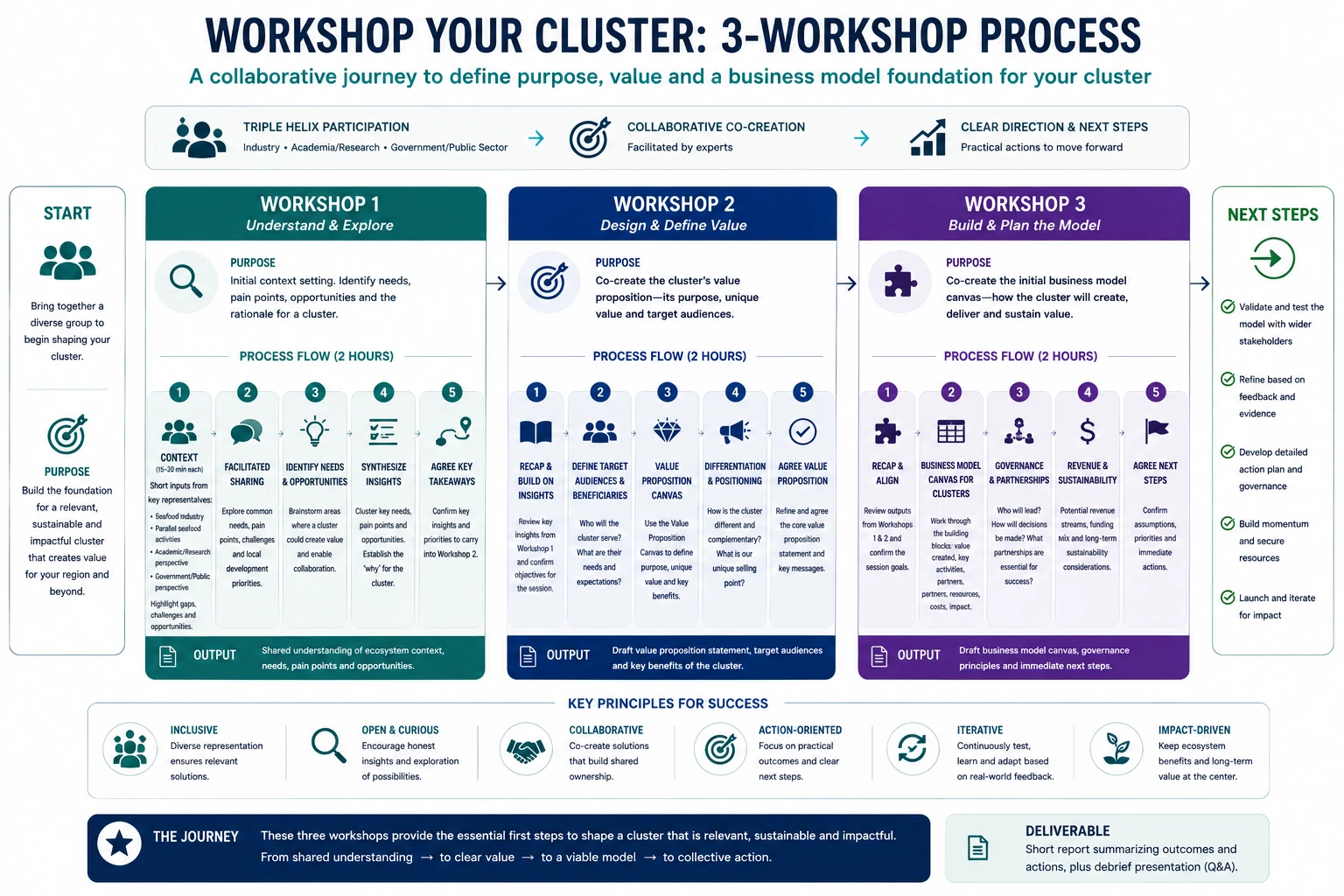
The workshops work best with a small founding team whose members have well-informed views on how a utilization cluster would fit into the existing ecosystem, which pain points it would address, and how it could be structured. This is not yet stakeholder engagement. It is a development process for the people who will go on to build and lead the cluster. Each workshop builds on the last, moving the group from a shared understanding of context and needs (Workshop 1) to a shared value proposition (Workshop 2), to a workable first business model (Workshop 3). Together, they build shared ownership of the cluster’s design before committing money, space, or staff.
The process is most effective when led by an external facilitator with no stake in the cluster’s development. A neutral facilitator can keep discussions focused and steer the group toward productive outcomes and concrete development plans. Facilitation is also smoother when the facilitator has experience developing seafood utilization ecosystems, for example, a member of the Iceland Ocean Cluster team or of an established Sister Ocean Cluster.
Setting up the series
Participant selection
Who is in the room shapes everything the workshops produce. By the end of the series, the founding team should have a clear plan of action built on shared understanding of:
- What the local seafood ecosystem looks like today;
- The cluster’s value proposition;
- The needs it fills and how;
- How the cluster could be structured;
- Who will lead the cluster;
- Who will take which next steps, including when and how to open the discussion to broader stakeholders once a preliminary plan is in place.
In some places, a founding team will already exist and can work through the workshops together. In others, assembling the team will be part of workshop planning. Either way, the group should include one person who can speak for each of four perspectives:
- Seafood industry
- Academia and research
- Government and public sector
- Connectors, such as industry associations, networks, funding bodies or investors
The exact mix will differ in every ecosystem. What matters is that each perspective is represented by someone who knows their part of the ecosystem deeply, comes prepared, and is willing to collaborate with their peers. Keep the group small, three to seven people. This is not a stakeholder workshop but a direction-setting exercise for the people who will found and lead the cluster.
Logistics
Run the workshops as three separate sessions of 1.5 to 2 hours each, about one month apart. That gap gives participants time to reflect without losing momentum. In-person sessions work best because they allow face-to-face conversation and problem-solving. Hybrid or virtual formats also work when the facilitator and founding team are spread across different locations. Regardless of format, a live transcription tool should be used to make sure that the key points of discussion are captured.
Before Workshop 1, the facilitator should hold a separate preparation call with each participant. In Workshop 1 itself, after the facilitator sets the context, each participant shares their informed perspective on the local seafood ecosystem: its priorities, pain points, needs, capacities and strengths, and its potential for fuller utilization and higher-value products. This helps to build initial context for how a cluster could fit into the existing ecosystem. Participants can use visual aids if they and the facilitator prefer, but only pre-prepared content is required.
The three workshops
The goal of the three workshops is not a finished cluster but a strong, co-created foundation that the founding team can test with wider stakeholders, refine, and develop into an actionable cluster strategy. Because each session is short, the facilitator’s role is central: setting the context clearly, sharing an agenda that makes the best use of limited time, and keeping the conversation focused and productive.
Workshop 1: Understand & explore
Purpose: Establish why a cluster is needed. Drawing on perspectives from industry, research and academia, and the public sector, participants explore the ecosystem’s needs, pain points, gaps and opportunities, and identify where a cluster could add meaningful value.
What should be achieved: By the end of Workshop 1, the founding team should agree on the regional seafood industry’s specific needs and pain points, and on the opportunities a 100% utilization cluster could create. This shared understanding sets the stage for Workshops 2 and 3.
See an example agenda for Workshop 1
Welcome and series overview (~10 min): The facilitator opens with an overview of the three-workshop series and the broad goal of each session:
- Workshop 1: Context setting (fit, needs, and opportunities).
- Workshop 2: Developing the value proposition and cluster messaging.
- Workshop 3: Initial business model development.
They then introduce the goals and agenda for this first session.
100% utilization context (~20 min): In every workshop, the facilitator grounds the activities in one or more examples of successful 100% utilization ecosystems. In Workshop 1, this means explaining how and why other clusters were established, with a brief look at their problem statements and value propositions. This works best as a story, ideally told by someone who has been involved in developing a cluster. For example, the facilitator might describe how the Iceland Ocean Cluster was formed and why, and how it later helped set up sister clusters such as the New England Ocean Cluster in Portland, Maine.
Founding team presentations (~10 to 15 min each): The facilitator explains the running order and how long each participant has, then keeps presentations on time. Adjust the time per speaker to the size of the group and share the schedule with participants in advance. Anyone using slides should send them to the facilitator beforehand so they can be merged into the main presentation.
Discussion: needs, pain points and opportunities (~30 min): The facilitator briefly recaps what the presentations revealed, then opens a live discussion on the region’s needs, pain points and opportunities. Using guiding questions, they build on useful contributions and redirect tangents that aren’t relevant.
Takeaways and next steps (~10 min): The facilitator summarizes the biggest needs and opportunities identified and checks that participants agree. They close by previewing Workshops 2 and 3 and asking whether anyone who is missing should join the next sessions, or whether they should reduce the number of participants to a smaller but representative group.
Workshop 2: Design & define value
Purpose: Identify who the cluster is for and what unique value it will provide. Building on Workshop 1, participants identify priority audiences and beneficiaries and co-create an initial value proposition that sets out the cluster’s purpose, benefits and differentiation.
What should be achieved: By the end of Workshop 2, the founding team should agree on a draft value proposition that names who the cluster serves, where, why it is needed and how it will deliver value, and that distinguishes it from organizations already working in the region.
See an example agenda for Workshop 2
Recap of the series and Workshop 1 (~15 min): The same facilitator who led Workshop 1 should lead Workshop 2 for continuity. They briefly revisit the three-workshop series and explain that this session focuses on drafting the cluster’s value proposition and messaging. They then recap Workshop 1’s main takeaways, especially the region’s biggest needs and opportunities, and introduce this session’s goals and agenda.
100% utilization context (~20 min): Building on the examples from Workshop 1, the facilitator explains what makes a good value proposition, then walks through the value propositions of the same example clusters. A strong value proposition answers who, where, why, and how, and offers:
- A clear, concise message.
- A purpose relevant to the community it serves.
- A unique value.
- A message that resonates emotionally.
For each example, the facilitator shows where these elements come together.
Founding team presentations (~10 to 15 min each): Founding team members again prepare short presentations in advance and share them with the facilitator. These are most useful when they set the stage directly for the value proposition, for example with some participants outlining the region’s top priorities and others its relevant capabilities. The facilitator then summarizes where pre-competitive collaboration could create value for the region’s seafood industry, such as:
- Making the case to government.
- Attracting a future workforce and building skills.
- Collaborative R&D.
- Addressing industry-wide challenges and priorities.
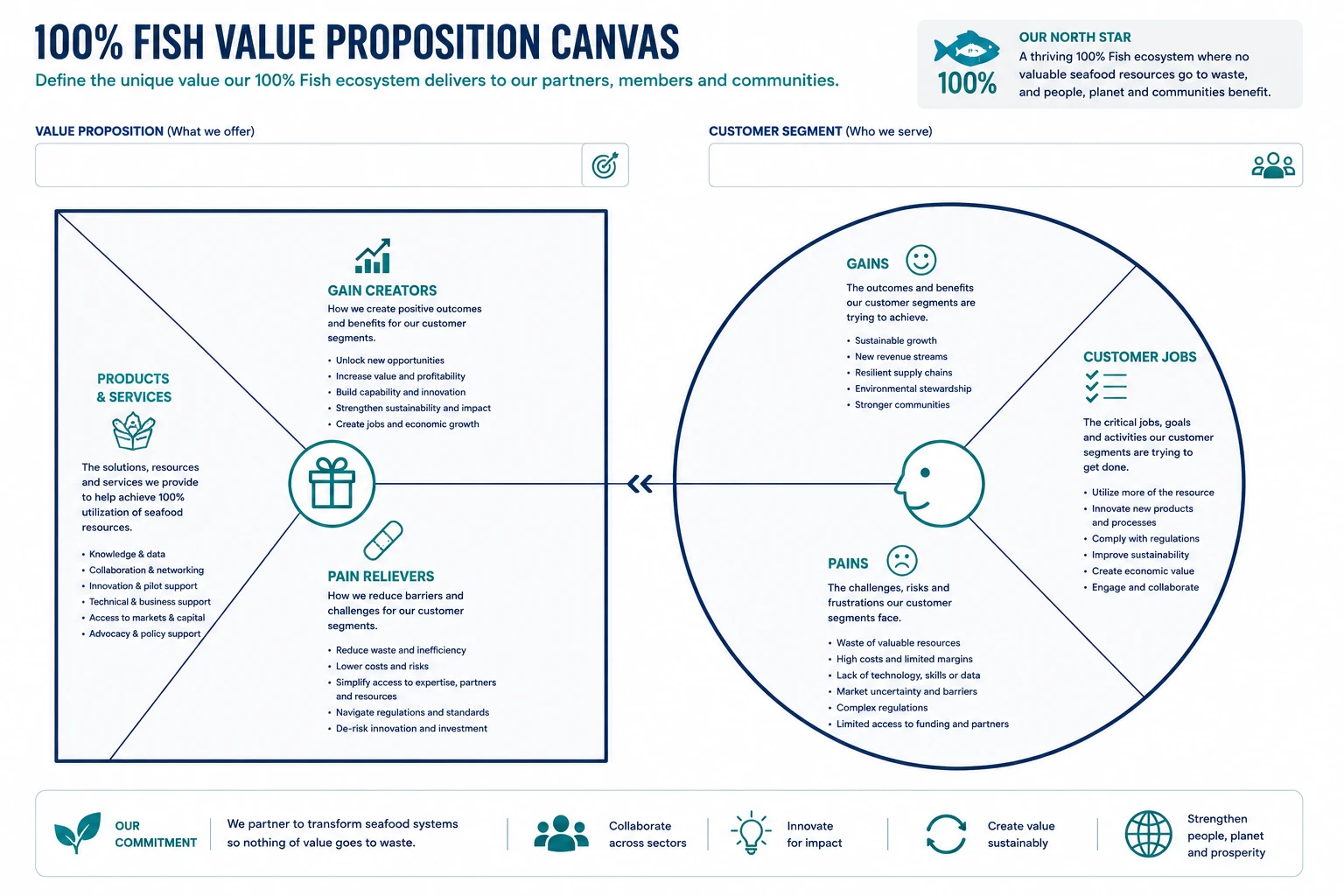
Value proposition development (~30 min, the core of this workshop): The facilitator guides the group in drafting the value proposition. The format can match the group’s working style: some groups prefer open discussion, others visual tools. One helpful tool is the 100% Fish Value Proposition Canvas (below), which links the needs of the people the cluster aims to serve directly to the value it could provide. The facilitator should decide in advance whether to use the canvas. If not, they should plan a structured conversation that follows the same logic.
Agreement and next steps (~10 min): The facilitator summarizes the draft value proposition, covering who, where, why, and how, and checks that participants agree. They close with a brief preview of Workshop 3.
Workshop 3: Build & plan the model
Purpose: Establish how the cluster can work in practice and be sustained. Participants translate the emerging purpose and value proposition into an initial business model, considering activities, partners, resources, governance, revenue and sustainability, and agree on the priority actions needed to move forward.
What should be achieved: By the end of Workshop 3, the founding team should have a draft business model with priority revenue streams, a list of potential first followers and starter projects, a clear sense of who will lead, and agreed next steps.
See an example agenda for Workshop 3
Business model context (~30 min): Rather than opening with a recap of Workshops 1 and 2, Workshop 3 goes straight into business models and brings in earlier work where it is most relevant. The facilitator should be able to explain in detail how existing clusters operate, through first-hand experience or thorough research. For continuity, use the same example cluster as in Workshops 1 and 2, focusing on how it generates revenue: where each revenue stream comes from and how it was first established. Brief overviews of the main revenue streams of one or two other clusters can show the range of possible structures.
Value proposition recap (~10 min): The facilitator briefly recaps the value proposition from Workshop 2. To help identify revenue streams, it can be useful to break it into three parts:
- Cluster value proposition: how it supports the seafood ecosystem.
- Location value proposition: why this location.
- Network value proposition: what the wider cluster network brings.
Revenue streams and business model (~40 min, the core of this workshop): Building on the example presented earlier, the facilitator guides the group in deciding which revenue streams to pursue and how they could fit together into a draft business model. Useful questions include:
Revenue and resources
- Which, if any, of the example revenue streams fit the cluster’s value proposition?
- Which revenue streams or funding sources seem most accessible, or have the highest potential?
- Are there assets that could be monetized through strategic partnership or financing?
- What partnerships or in-house capacity would the cluster need to access these revenue streams?
- Which grants, funding mechanisms or government incentives best suit the most promising streams?
Early supporters and starter projects
- Which companies, organizations or sponsors could be first followers and champion the cluster?
- Which high-impact, low-cost projects, aligned with the revenue streams, could the cluster launch first?
If the group finds a visual aid helpful, the business model canvas (below) can guide the discussion.
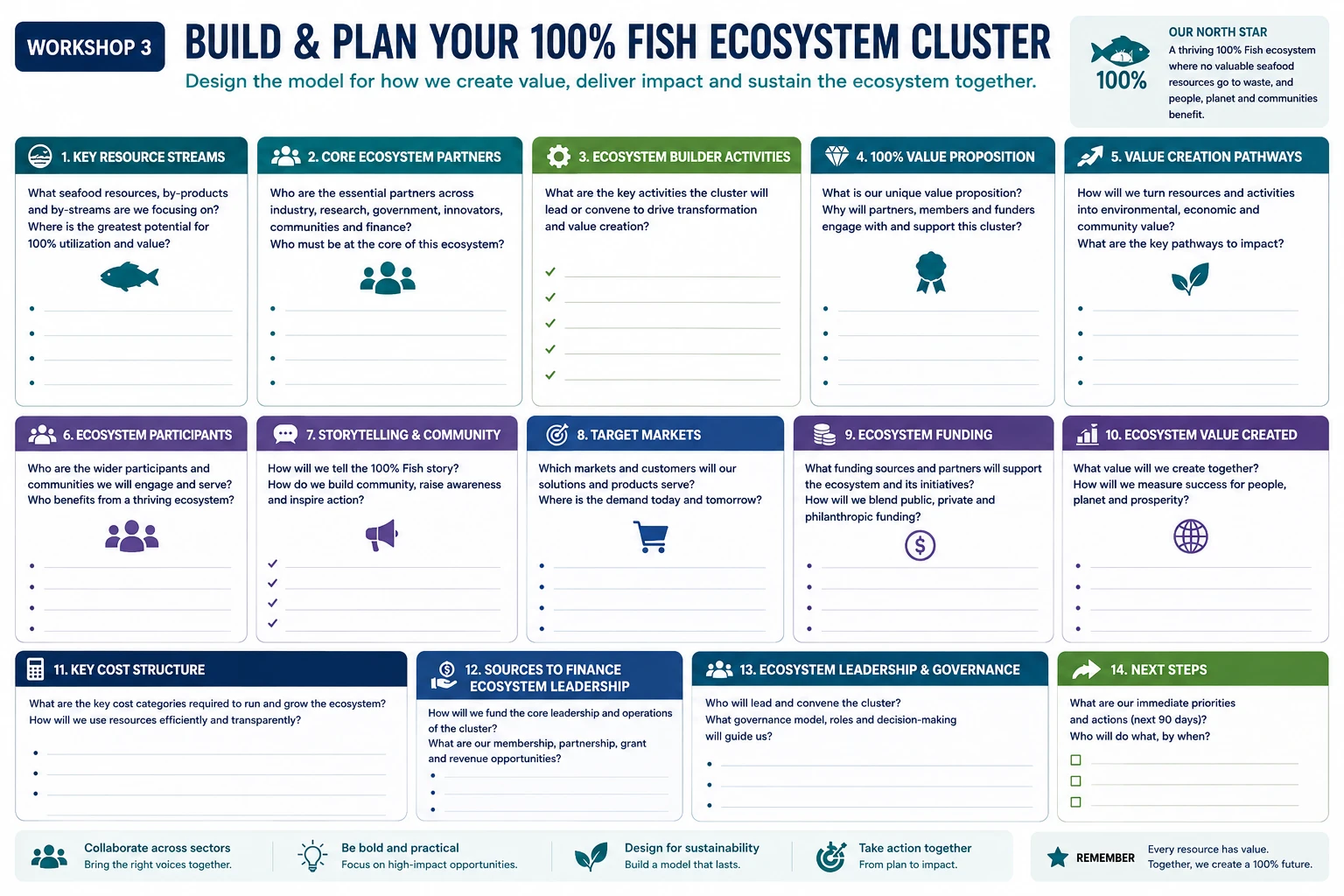
Leadership, partnerships and next steps (~15 min): A full business model can’t be finalized in one session, but the groundwork should be laid. The facilitator summarizes the discussion and identifies which areas need the most work going forward. They then guide a short discussion on:
- Leadership: who will take responsibility for making sure the cluster materializes.
- Partnerships: who else could help, and how to bring them in if they aren’t already involved.
Follow-up: As the final workshop, Workshop 3 should end with next steps agreed by the founding team. The series can then be followed by a written report or summary, or by a presentation of the plan to the wider ecosystem and stakeholders.
Facilitation tips
The facilitator’s job is to make sure each workshop delivers its intended outcomes and that the process keeps moving in the right direction. This is why it matters that the facilitator has no stake in the cluster’s development: a neutral facilitator can steer the group without pushing an agenda of their own.
Before the workshops
- Align everyone on the goal: Every participant should arrive knowing both the overarching goal of the series and the specific goal of each workshop. The goal is not seafood collaboration in general but building a 100% utilization ecosystem.
- Keep the group small and focused: A large or unaligned group is the most common way these workshops go off track.
- Schedule full attendance: Choose times when everyone can take part for the whole session, but plan for some late arrivals and early departures.
During the workshops
- Tell the story of cluster development. Give the founding team a vivid sense of how and why other clusters were built. A good story makes the possibilities concrete.
- Keep presentations short so most of the time goes to discussion.
- Pause to summarize. Regularly recap what has been said and check whether the group agrees or disagrees.
- Manage tangents. Let useful tangents run but redirect any that doesn’t serve the workshop’s goal.
Between the workshops
- Adapt as you go. After Workshop 1, adjust the plans for Workshops 2 and 3 based on how the group works together and what challenges have come up.
Next steps
After the three workshops, you can write a report that captures the outcomes and send it to a broader group, to test the value proposition, formalize the business model, build the roadmap to move forward, and develop the story. Keep the steps that follow simple:
- Test your assumptions with the wider stakeholder group, especially entrepreneurs, research, the regulatory environment and industry: are the assumptions correct, and is there a mandate to create this? Test the value proposition from a business perspective, too: the Scottish Ocean Cluster’s story shows how. Here it is highly valuable to connect with existing successful examples around the world, to help build stakeholders’ confidence in what has worked.
- Plan your resources: the personnel, economic and time resources you will need to build the roadmap.
- Then seek the financial resources to implement it.
See the workshops in action: the emerging Grimsby ecosystem